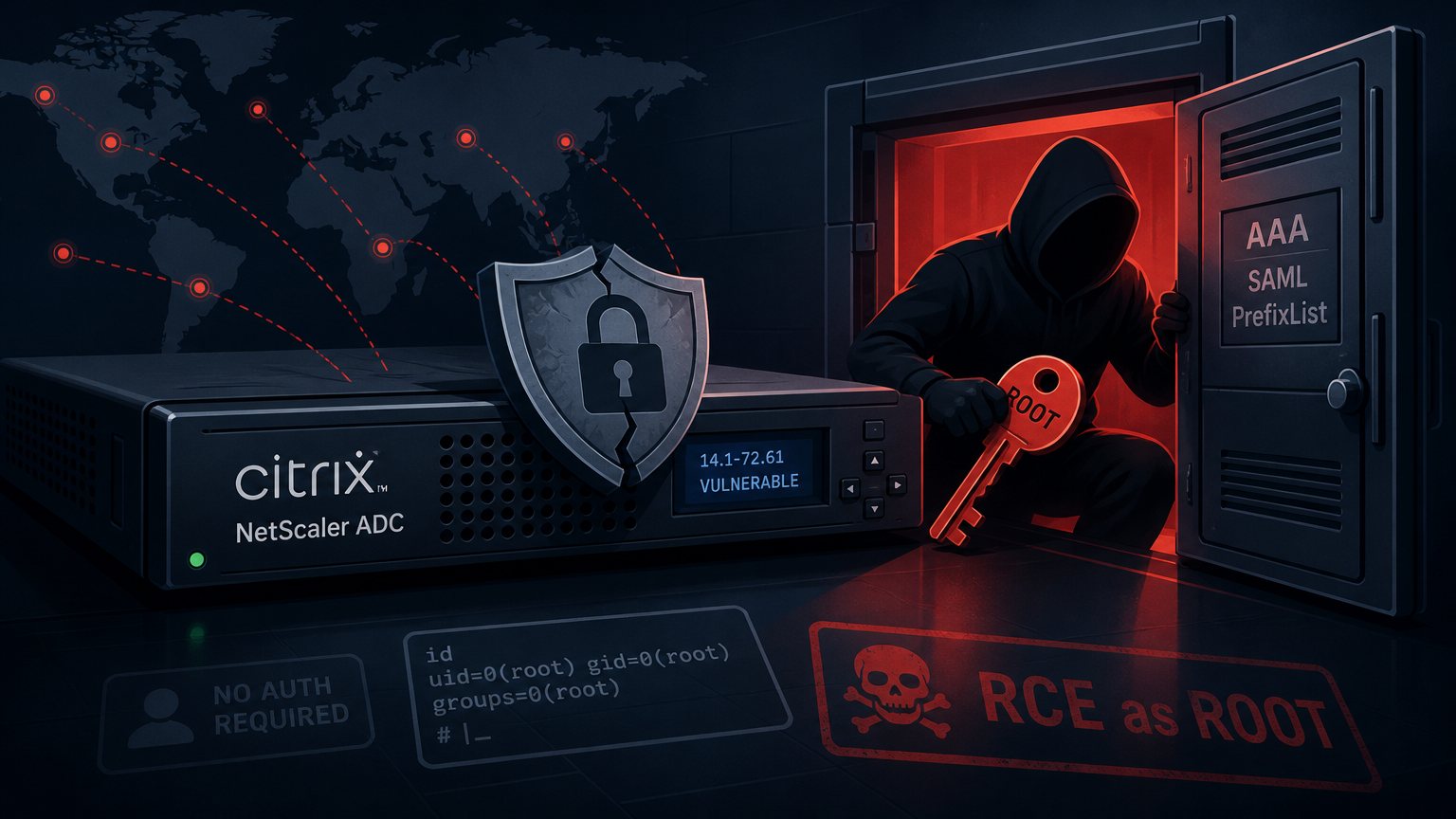
Citrix’s June 30 advisory described CVE-2026-8452 as a memory overflow in NetScaler ADC and NetScaler Gateway that “may only lead to denial of service.” On August 14, watchTowr Labs published research showing that the flaw could give an unauthenticated attacker remote code execution as root.
By August 30, 2026, exploitation had been confirmed, attackers had deployed webshells, and a federal remediation deadline had passed. The difference between the initial description and the demonstrated impact matters for teams that used the advisory to set their patch priorities.
From a service outage to root access
Citrix rated CVE-2026-8452 high-severity and released patches on June 30. That rating warranted attention even under the original denial-of-service description. An outage on a gateway can interrupt access to an entire organization. Still, an advisory describing downtime gives infrastructure teams a different basis for triage than one describing an attacker taking control of the appliance.
The affected configurations include NetScaler appliances deployed as a Gateway VPN, ICA Proxy, CVPN, RDP Proxy, or AAA virtual server. These systems handle remote access and authentication at the network perimeter. Shadowserver reported more than 22,000 NetScaler ADC instances and more than 1,800 Gateway instances directly exposed to the public internet. Those exposure counts indicate the potential reach of an attack, not the number of confirmed compromises.
On August 14, watchTowr Labs published a technical analysis and working proof-of-concept code. The researchers identified a heap memory overflow triggered by malformed SAML PrefixList processing in the AAA service. A heap overflow corrupts memory allocated by a running program. Depending on how that corruption can be controlled, the result may extend beyond a crash.
According to watchTowr’s analysis, careful exploitation allows full, unauthenticated remote code execution as root. A specially crafted SAML request to a vulnerable endpoint is enough to reach the flaw. No credentials or existing access are required. Root access gives the attacker control of a network appliance positioned between the public internet and internal systems.
CVE-2026-8452 carries a CVSS score of 8.8. Three days after watchTowr’s publication, the Canadian Centre for Cyber Security confirmed active exploitation. That puts public confirmation of attacks within 72 hours of the technical disclosure, though it does not establish when the attacks began.
A second vulnerability and another patch check
Citrix also disclosed CVE-2026-19490, an authentication bypass with a CVSS score of 9.3. Its classification is CWE-288: Authentication Bypass Using an Alternate Path. It allows an unauthenticated attacker to bypass the login requirement on affected appliances.
As of the reporting available on August 30, active exploitation of CVE-2026-19490 had not been confirmed. It affects the same products and deployment configurations as the actively exploited remote code execution flaw. Given the short interval between the watchTowr disclosure and confirmation of attacks, the operational recommendation is to patch this bypass urgently rather than wait for evidence of exploitation. That urgency should not be confused with a finding that attacks have already occurred.
The reported fixed versions for both vulnerabilities are NetScaler ADC and Gateway 14.1-73.32 and 13.1-63.21, or later builds. The June versions identified as fixed, 14.1-72.61, 13.1-63.18, and 13.1-37.272, are reported as insufficient for the remote code execution vector watchTowr demonstrated. Under that account, the June builds addressed the denial-of-service behavior without fully addressing the exploitable memory corruption.
The practical consequence is that a record showing “patched in June” is not enough. The installed build needs to be checked against the later fixes.
Reported attacks and the federal deadline
Threat intelligence firms describe broad, high-volume scanning for exposed NetScaler endpoints rather than attacks limited to selected organizations. Reported webshell filenames include x.php and z.php. A webshell is a script that lets an attacker issue commands through a web-accessible interface.
Attackers have been observed running basic discovery commands, including id and echo, before establishing persistence. The reported sequence involves checking command execution and access, then leaving a way to return to the appliance.
SecurityWeek reported exploitation across at least three countries. CISA added CVE-2026-8452 to its Known Exploited Vulnerabilities catalog on August 26 and set an August 29 remediation deadline for Federal Civilian Executive Branch agencies under Binding Operational Directive 26-04. As of August 30, that deadline had passed.
Organizations outside the federal sector are not covered by that same deadline, but the catalog entry is evidence of confirmed exploitation. It provides a stronger basis for urgent action than the availability of proof-of-concept code alone.
Patch status and compromise status are separate checks
An exposed appliance needs both a version check and an assessment for intrusion. Installing a fix closes the vulnerability; it does not establish that an attacker’s backdoor has been removed.
- Inventory the affected deployments. Identify appliances configured as Gateway VPN, ICA Proxy, CVPN, RDP Proxy, or AAA virtual servers. Record their installed builds and whether they are reachable from the internet.
- Update to the reported fixed builds. The minimum versions listed for both CVE-2026-8452 and CVE-2026-19490 are 14.1-73.32 or 13.1-63.21. The June builds, 14.1-72.61, 13.1-63.18, and 13.1-37.272, are reported as insufficient for the remote code execution vector.
- Investigate appliances exposed after August 14. Treat an appliance running a vulnerable version after publication of the proof of concept as potentially compromised. Look for
x.phpandz.phpin the web root, unexpected outbound connections, lateral movement from the appliance’s IP address, and new scheduled tasks or other persistence mechanisms. - Check Shadowserver’s dashboard. Its tracking can help identify exposed NetScaler instances. An address reported as vulnerable is a reason to act, but an internal inventory should not depend on an external scan finding every appliance.
- Isolate suspected compromises before patching. For an appliance exposed and unpatched after August 14, the recommended recovery sequence is isolation, forensic triage, a clean reinstall or restoration from a known-good snapshot, and patching before public access is restored. A patch alone can leave an installed backdoor intact.
How much weight to give the original advisory
Vendor severity ratings are useful starting points, but they describe what is known and documented at a particular time. With memory corruption flaws, the difference between a reproducible crash and reliable code execution can depend on further exploit development. The impact demonstrated at disclosure may not be the maximum impact a skilled researcher can achieve.
The NetScaler case illustrates an additional triage problem: an advisory’s narrow description can lead teams to underestimate a flaw even when its formal severity rating is high. Here, the denial-of-service framing did not reflect the root-level access watchTowr later demonstrated.
A cautious patch policy for critical perimeter appliances should give high priority to fixes involving authentication, session handling, or memory management, including consideration of possible remote code execution while the impact remains uncertain. Independent research from watchTowr, Rapid7, Tenable, and similar teams can help refine that assessment. Waiting for a CISA deadline leaves less time for testing, recovery, and investigation.
NetScaler appliances have faced repeated exploitation campaigns over recent years. Their internet exposure and trusted position inside networks make them valuable targets. A webshell on one can provide persistent access and a starting point for lateral movement, with the reach depending on internal access controls.
Affected operators need to verify the installed build, investigate vulnerable exposure, and use the incident response process where compromise is suspected. Reports of active exploitation from researchers or national cyber agencies warrant action within hours rather than another routine patch cycle.