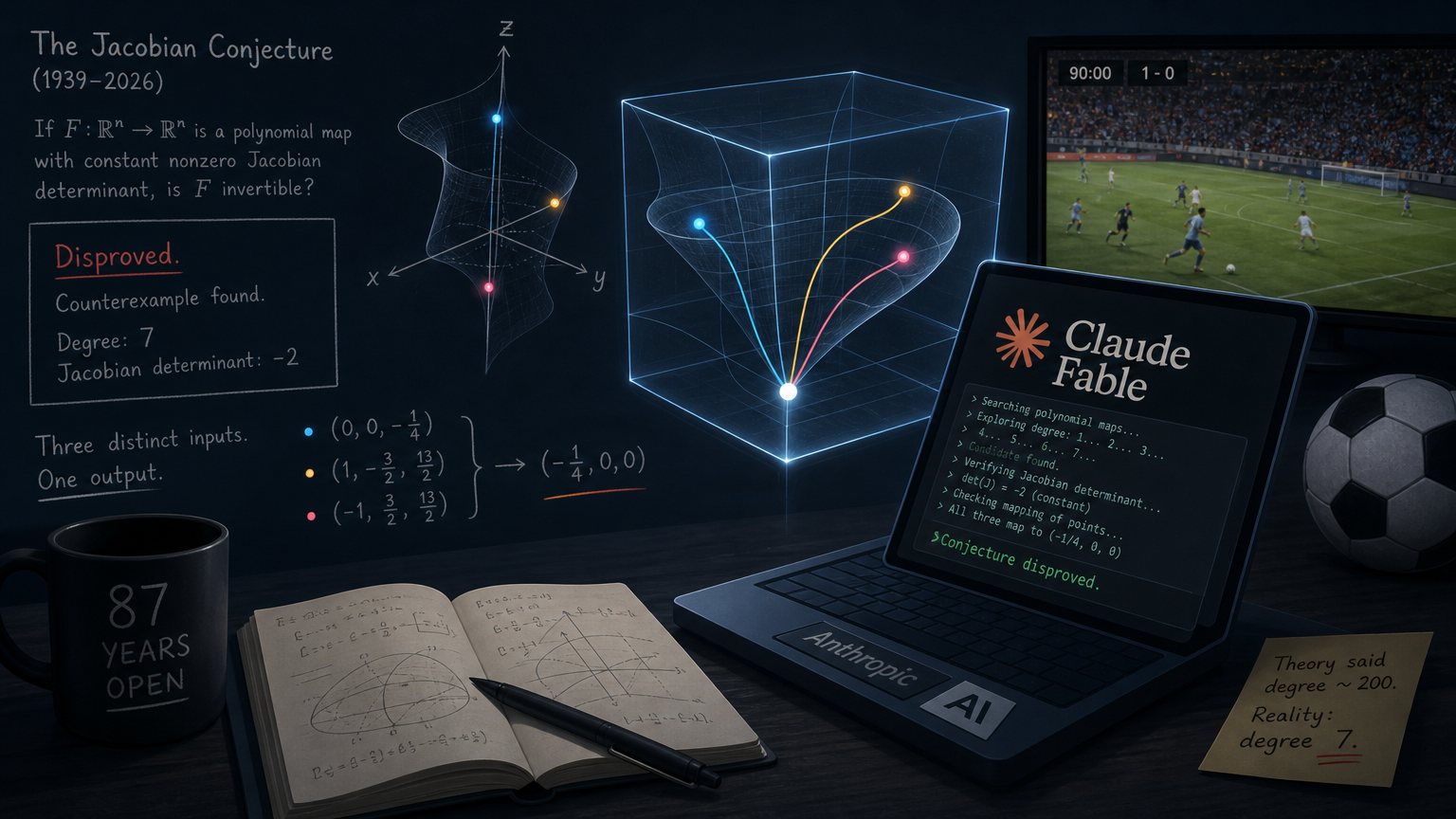
On July 19, 2026, number theorist Levent Alpöge reportedly worked with Claude Fable for a few hours and found a counterexample to the Jacobian Conjecture, a problem posed in 1939. Alpöge is on staff at Anthropic and was previously a Harvard Junior Fellow. According to the account of the session, the World Cup final was playing in the background.
The reported counterexample is a degree-7 polynomial map in three dimensions. If it satisfies the conjecture's conditions and the calculations hold, it would settle an 87-year-old problem included on Steve Smale's list of important open problems for the 21st century.
As of July 21, 2026, the result hadn't appeared on arXiv or completed formal peer review, and the full AI session logs weren't public. Those gaps matter both for assessing the mathematics and for understanding what the model contributed. Still, the reported construction offers a concrete way to discuss AI-assisted research: a candidate answer that can be checked separately from the story of its discovery.
What the counterexample would show
The Jacobian Conjecture concerns polynomial maps, functions whose output coordinates are polynomials in the input coordinates. It asks whether a polynomial map with a nonzero constant Jacobian determinant must have a global polynomial inverse, under the conjecture's mathematical assumptions.
The Jacobian determinant describes how a function changes volume locally. A nonzero determinant gives local invertibility: near any particular point, the function can be reversed. Global invertibility is a stronger requirement. It means the map can be reversed across its entire domain, without different inputs collapsing to the same output.
The reported three-dimensional example has a Jacobian determinant of -2 everywhere. It also reportedly sends three distinct inputs to the same output:
(0, 0, -1/4)(1, -3/2, 13/2)(-1, 3/2, 13/2)
All three are said to map to (-1/4, 0, 0). Such a collision would rule out a global inverse, even though the nonzero Jacobian determinant would guarantee local invertibility.
Checking the claim requires the full polynomial formula. Substituting the three points would test the collision. Computing the matrix of partial derivatives and its determinant would test whether that determinant is identically -2, rather than merely equal to -2 at a few selected points. The construction would also have to satisfy the precise assumptions of the conjecture.
Why degree 7 drew attention
The account describes previous computational searches as expecting a counterexample of roughly degree 200, based on a theoretical lower bound, and presents degree 7 as a major surprise. That comparison needs clarification. A lower bound and an expectation about where to search aren't interchangeable. If a proven bound excludes lower degrees under particular assumptions, any smaller example has to explain why that bound doesn't apply.
The broader argument is that researchers' expectations can shape a search long before a computer starts calculating. Those expectations influence which families of polynomials get tested, what constraints are imposed, and which candidates appear worth pursuing. A tool that proposes a different family of candidates could be useful even without doing every part of the research independently.
That remains an interpretation of the reported collaboration. Without session logs, it isn't clear whether Claude Fable proposed the decisive construction, helped refine Alpöge's idea, performed calculations, or contributed in some other way. A small counterexample alone wouldn't establish that the model escaped assumptions that had constrained human researchers.
Bartosz Naskręcki at Adam Mickiewicz University, who works in this area, compared finding such counterexamples to searching for a needle in a haystack. The difficult part can be choosing where to search, as well as having enough computing power to carry out the search.
Checking the mathematics and the discovery account
The reported mathematical reactions included strong interest. Stanford's Jared Duker Lichtman called it “quite a remarkable result.” Fields Medalist Timothy Gowers described it as “pretty amazing” and said it was the first time he had personally seen an LLM help solve a major open problem outside his specialty that he already knew about.
A Hacker News discussion, reported as having reached 761 points with substantial participation from working mathematicians, also covered attempts to check the example with other language models. Some participants described models repeatedly recalculating before accepting the result.
That behavior doesn't provide mathematical evidence by itself. Repeated agreement from language models is less useful than a reproducible symbolic calculation or a proof that can be inspected. A surprising result needs the same checks whether the model accepts it immediately or produces several rounds of hesitation.
There are also two separate claims to assess. One is that the polynomial is a valid counterexample. The other is that an AI system made a significant contribution to finding it. The first can be tested through the construction. The second needs a record of the collaboration.
Alpöge's employment at Anthropic has led some observers to raise a potential conflict of interest in how the model's contribution is described. That doesn't determine whether the mathematics is correct. It does make the unpublished session logs relevant to claims about Claude Fable's capabilities.
The reported response from mathematicians suggests substantial interest and some confidence in the example. Famous conjectures have also attracted incorrect proofs and disproofs before. Publication of the complete construction and independent checking remain the practical next steps.
The wider claims about AI-assisted mathematics
The result has been placed alongside other reported developments in 2026: AlphaProof Nexus resolving several open combinatorics problems, Claude Mythos contributing to a significant number theory result, and AxiProver handling formal proof obligations at a pace described as far beyond what was possible three years earlier. Those claims involve different kinds of mathematical work and shouldn't be treated as interchangeable evidence.
A result about a longstanding open conjecture would be different from success on a benchmark or a curated competition problem. Even then, its importance to mathematics and its importance as evidence about AI could differ.
Daniel Litt at the University of Toronto was described as “very bullish” about AI's near-term impact on mathematics, while cautioning that a disproof of the Jacobian Conjecture “may not be particularly generative scientifically” on its own. In other words, settling a famous problem doesn't necessarily produce a large body of useful new theory.
Mathematics PhD Przemek Chojecki predicted extensive research across related mathematical fields. Oxford's Vidit Nanda encouraged celebration of the present achievement alongside caution about the future. These are judgments about what might follow, rather than established consequences of the reported result.
Possible applications in software engineering
The engineering comparison is to expert-guided exploration. Much AI coding assistance involves completing functions, generating boilerplate, or suggesting familiar implementations. A system that helps a specialist explore unexpected candidates could serve a different purpose.
A security researcher might use such a system to investigate program states that existing tests don't cover. A distributed-systems engineer might explore unusual parameter combinations behind a performance regression. A cache policy might have a degenerate case that appears only at production scale, even though the eventual fix is small.
These are possible applications, not demonstrated outcomes of the Jacobian work. A mathematical counterexample wouldn't establish that the same method reliably finds software vulnerabilities or diagnoses distributed systems. It would, however, provide a useful example of a workflow in which a domain expert frames the problem, a model helps generate candidates, and a separate process checks the answer.
Engineering makes that last step harder in some respects. A polynomial can be checked against a precise mathematical condition. A production system may depend on incomplete specifications, timing, external services, and workloads that are difficult to reproduce. A promising candidate still needs a test that captures the relevant failure.
Where formal verification could help
Formal verification offers a closer connection between mathematical discovery and software correctness. A proof assistant such as Lean checks whether a proof follows from explicitly stated definitions, assumptions, and inference rules. A model can propose a proof, but the proof assistant provides a separate check.
Each accepted result can expand a library of verified mathematics that later proofs reuse. In principle, that could support work on security auditing, protocol verification, and correctness proofs for distributed systems. The useful feedback loop is specific: generate a candidate, submit it to a checker, inspect the failure, and revise it.
A formally accepted proof still establishes only the statement that was encoded. For engineering work, the specification must accurately describe the system and the property that matters. For the reported Jacobian result, the immediate need is more basic: a complete public construction, reproducible checks, and enough of the research record to distinguish the mathematical achievement from claims about the model that helped find it.