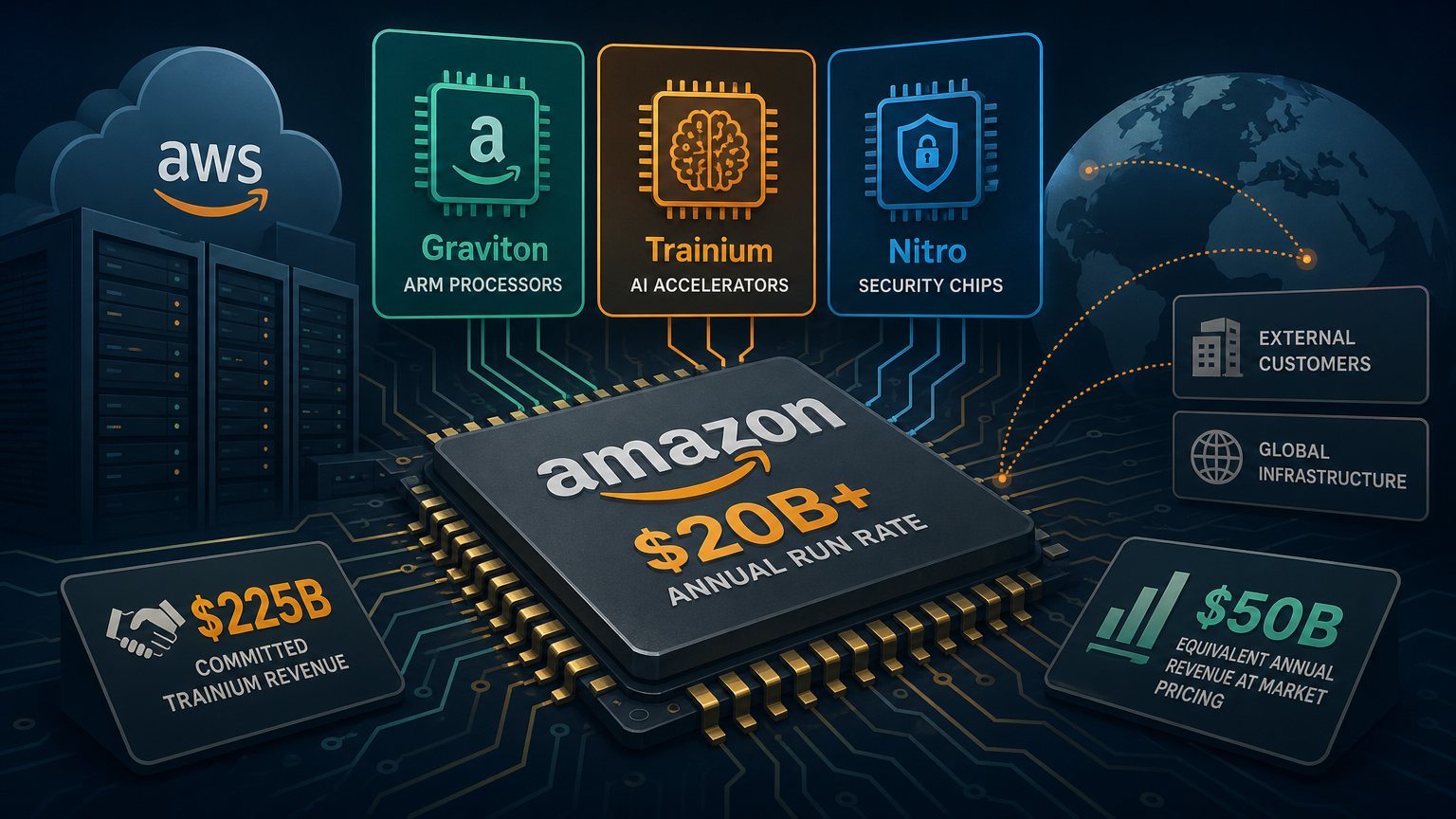
Amazon disclosed a custom silicon business with more than $20 billion in annual revenue run rate during its April 29 Q1 2026 earnings call. CEO Andy Jassy said the business, which includes Graviton processors, Trainium AI accelerators and Nitro security chips, was growing at a triple-digit rate year over year.
AWS revenue received much of the attention: $37.6 billion, up 28%, its fastest growth in fifteen quarters. But the silicon disclosure deserves a closer look. Amazon’s chips are becoming a substantial business, with consequences for infrastructure buyers who have mostly treated AWS as a cloud provider.
When Graviton arrived in 2018, its ARM-based design looked primarily like a way for Amazon to reduce computing costs and its dependence on x86 processors. That remains part of the case. The scale of the business now raises a different question about how far Amazon intends to go as a chip supplier, including outside its own cloud.
What the revenue figures mean
Alongside the $20 billion run rate, Amazon has secured approximately $225 billion in committed Trainium revenue. Major agreements with Anthropic and OpenAI anchor that total, covering multiple years and multiple gigawatts of capacity.
These commitments suggest a supply-planning relationship closer to long-term semiconductor procurement than ordinary, variable cloud consumption. Their scale invites comparison with commitments made to manufacturers such as TSMC or Samsung, though that comparison alone doesn't establish that the contracts have the same terms or delivery model.
Jassy offered another measure in his shareholder letter. If Amazon’s custom silicon operation were a standalone company selling chips to AWS and third-party data centers at market prices, he said, its equivalent annual revenue would be approximately $50 billion. That framing describes the estimated market value of the business, including what its chips replace internally. It isn't a disclosure of $50 billion in external chip sales.
The comparison nevertheless gives a sense of Amazon’s ambitions. It asks investors to evaluate the silicon operation as a chip business in its own right. It also supports the expectation that Amazon may eventually sell chips outside AWS, although it doesn't confirm such a program.
The significance of the Meta agreement
The most consequential development for general-purpose computing may be Graviton5 rather than Trainium. Meta, a major rival in AI infrastructure, signed a multibillion-dollar agreement to deploy tens of millions of Graviton5 cores for its workloads.
Graviton has historically been available through EC2, AWS’s service for renting computing capacity. The Meta agreement shows the size of the external customer demand Amazon can attract for its own processor designs. Whether it also establishes a model for selling physical chips outside AWS is an important distinction.
If the arrangement extends beyond EC2 access, it would open a different distribution model for Graviton. Amazon already combines chip intellectual property, fabrication partnerships and a large cloud sales channel. Direct chip sales would add a customer base that doesn't need to run those processors in Amazon’s data centers.
For infrastructure buyers, the delivery model matters as much as the core count. Buying access to Graviton through AWS and buying Graviton hardware for another facility involve different operating responsibilities and different forms of vendor dependence.
Trainium3 supply is the immediate constraint
Trainium3 began shipping in early 2026. Amazon claims a 30% to 40% price-performance improvement over Trainium2. That would be a useful gain, but it remains a vendor claim, and access may be the more pressing issue: Trainium3 is reportedly already nearly fully subscribed.
The $225 billion in commitments therefore cuts both ways. It gives Amazon substantial contracted demand, while raising questions about how much capacity remains for other customers. A midsize AI startup, an enterprise building internal inference systems or a cloud operator seeking an alternative to NVIDIA H100 costs may face a different availability picture from Anthropic or OpenAI.
Access through Amazon Bedrock, its managed service for AI models, also isn't equivalent to reserving dedicated Trainium capacity. The more than 125,000 customers using Bedrock consume managed infrastructure. That customer count doesn't establish how much Trainium capacity an individual organization can secure, or on what schedule.
Amazon is spending heavily to expand supply. Capital expenditure reached $44.2 billion in Q1 2026, up 77% year over year, within a roughly $200 billion plan for the full year. That spending reflects the scale of the buildout, but it doesn't mean new capacity will be available immediately. Chips, data centers and the infrastructure that powers them have separate delivery schedules.
Procurement and operating tradeoffs
Alternative accelerators could strengthen buyers’ negotiating position. NVIDIA has held considerable pricing power over the past three years. Trainium, AMD’s MI300X and Google’s TPUs are providing alternatives for some training and inference workloads, particularly at the largest scale.
Jassy’s $50 billion market-price comparison can also be read as a negotiating signal to NVIDIA. Large enterprises have reason to bring credible alternatives into procurement discussions. The value of that pressure depends on whether an alternative can run the required workloads and whether enough capacity is available. A lower quoted compute price isn't useful if the deployment can't proceed.
External chip sales would change the lock-in decision. Reporting dated June 18 suggested that Amazon was actively evaluating Trainium sales to colocation data centers and private cloud operators. As of July 20, 2026, that possibility should still be treated as a proposed option rather than an established purchasing channel.
Such a program could let customers use Trainium without hosting the workload on AWS. The tradeoff is that buying the silicon wouldn't automatically include AWS’s managed interconnect fabric, Bedrock integration or SageMaker ecosystem. Moving the hardware outside AWS could provide more control over deployment while leaving the buyer responsible for more of the surrounding system.
Committed revenue is a reason to ask about delivery dates early. The size of the Trainium backlog suggests substantial future production is already committed. Organizations considering a shift in AI compute during 2026 or 2027 should discuss reserved capacity with AWS before making that shift central to their plans.
One risk is that meaningful new allocations could slip into 2028. That is a planning forecast, not a confirmed reservation window. The dollar value of the backlog alone doesn't reveal shipment timing, manufacturing expansion or the capacity available to a particular customer. Contracted delivery dates are more useful than a general assurance that supply is growing.
The buildout extends beyond chips
Combined capital expenditure across Amazon, Microsoft, Alphabet and Meta is approaching $725 billion for 2026. At that scale, chip design is only one part of the problem. Advanced packaging capacity, which connects chips and memory in high-performance assemblies, can constrain supply. So can power-grid connections and cooling infrastructure.
Amazon’s Q1 financial reporting also showed free cash flow down 95%, to $1.2 billion from $25.9 billion a year earlier, as physical infrastructure investment absorbed much of the cash generated by operations. Even the largest cloud provider faces limits on how quickly it can fund and complete this expansion.
The industry’s spending assumes that AI compute demand will continue to grow enough to absorb the new capacity. If demand meets those expectations, supply could remain tight through much of the buildout. If demand falls short, excess capacity could eventually put downward pressure on cloud prices.
Amazon’s signed Trainium agreements give its investment plans more support than a demand forecast alone. They don't remove construction delays, manufacturing constraints or the risk that supply arrives at a different pace from customer needs.
Developments that would clarify the options
- A formal external Trainium sales program. An announcement before the end of 2026 is a reasonable expectation in this outlook, but remains a forecast. The useful details would be who can buy, where the chips can run and what support Amazon includes.
- Graviton5 availability beyond AWS. Listings in colocation catalogs or bare-metal offerings from smaller cloud providers would provide clearer evidence of a broader distribution model than the Meta core count alone.
- Trainium3 reservation windows. Published availability and customer-specific delivery commitments would help buyers judge supply more directly than revenue totals or performance claims.
- NVIDIA’s response. The H200 and B200 ramp, together with CUDA’s established software ecosystem, means the competitive outcome remains unsettled. The extent of any pricing pressure will show up in GPU contract negotiations, not just chip announcements.
Near-term infrastructure decisions depend on which workloads can move, how much capacity can be reserved, when it will arrive and which operating services come with it. Amazon’s silicon business is large enough to be considered in those decisions, though its scale doesn't yet make every proposed purchasing option available.