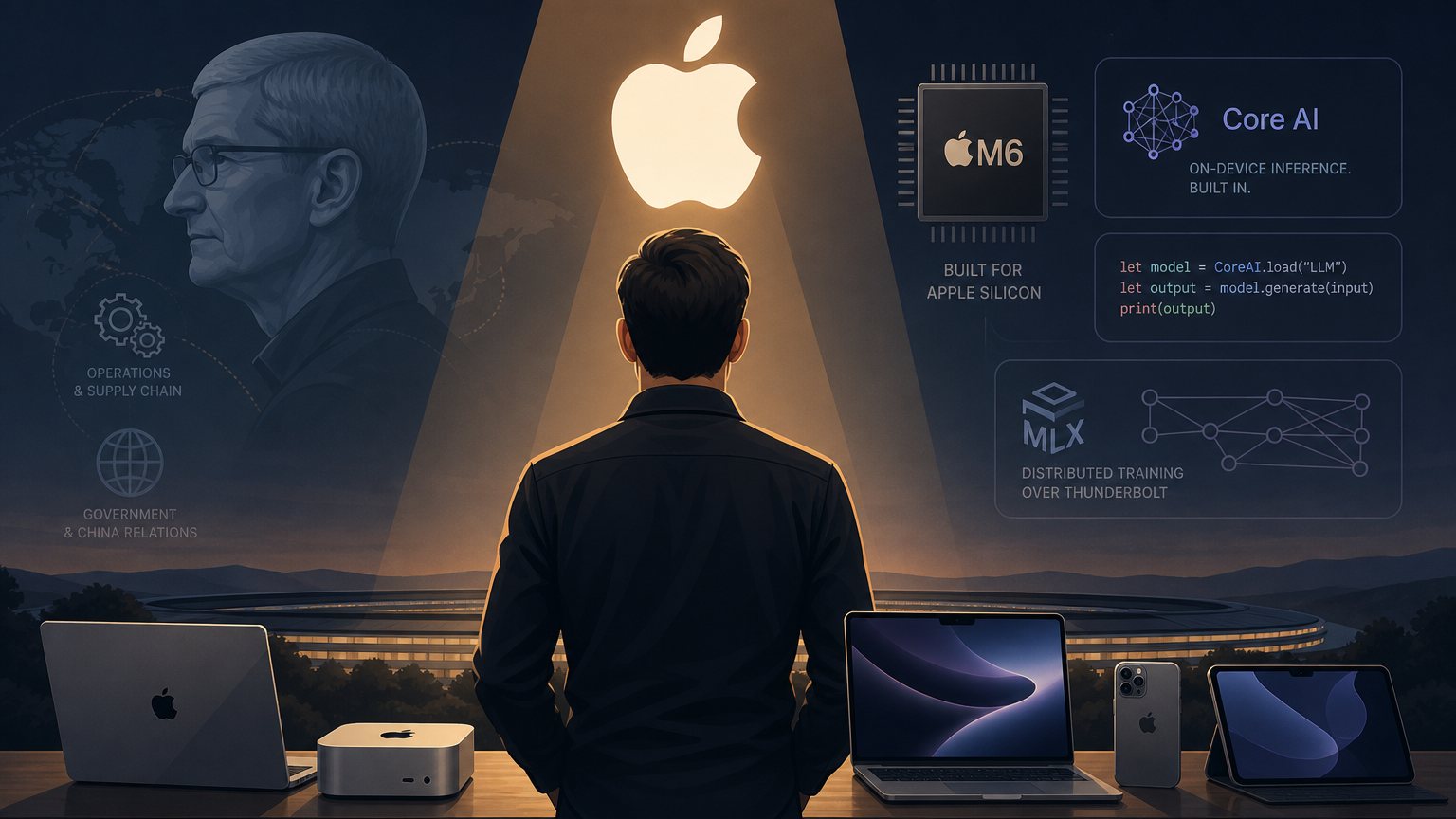
John Ternus takes over as Apple CEO today, September 1, 2026, ending Tim Cook’s fifteen-year run. Cook moves to executive chairman under the succession plan Apple announced on April 20. The new CEO is a mechanical engineer who has spent twenty-five years at Apple and overseen the hardware engineering behind its Macs, iPads and iPhones.
For developers and infrastructure teams that depend on those products, the question is whether Ternus will bring the software platform closer to the capabilities of the hardware. Apple Silicon has made Macs strong development machines and practical systems for local AI inference. The tools and frameworks around that hardware have been less consistent.
The hardware record behind the appointment
Ternus joined Apple’s Product Design team in 2001, became vice president of Hardware Engineering in 2013, and moved up to senior vice president in January 2021 when Dan Riccio stepped aside. He holds a B.S. in mechanical engineering from the University of Pennsylvania. His experience is in designing and shipping products, rather than finance or supply-chain operations.
The defining accomplishment of his senior vice president tenure is the Apple Silicon transition, from the M1 through the M6 announced in this week’s new Mac mini. There’s a reasonable case that it is the most consequential personal-computing platform shift since Intel’s Core architecture. The appeal extends beyond benchmark results. An M2 MacBook Air offers all-day battery life in a machine that fits in a sleeve, with compile performance that can exceed a Mac Pro from five years earlier.
Moving the Mac to Apple-designed chips also required coordination across much more than processor design. Board layouts, operating-system kernel changes, developer tools and manufacturing all had to move together. Rosetta 2, Apple’s binary translation system, provided compatibility for software built for Intel Macs. The supply chain had to adopt new chip substrates without losing a product cycle.
Cook’s operational expertise supported the manufacturing side. Ternus’s hardware organization had responsibility for turning the architecture into shipping products. That record gives developers a reason to expect close attention to what Apple’s hardware can enable. It doesn’t establish how he will run every other part of the company.
Cook’s scale, and the software gap
Cook became CEO on August 24, 2011. During his tenure, Apple became the world’s most valuable enterprise, with annual revenue rising from roughly $65 billion in fiscal 2010 to more than $400 billion. Its services business, including the App Store, iCloud, Apple TV+ and Apple Music, grew beyond $100 billion annually. That recurring revenue helps offset variation between hardware cycles.
Reliable supply-chain execution at that scale was a major achievement. For teams shipping software, though, Apple’s AI and developer tools often fell short of the hardware’s ambition.
Apple Intelligence, announced at WWDC 2024, arrived late and in stages, spending its first year catching up with features competitors had already shipped. Core ML remained capable, but its treatment as a platform for production AI workloads was less convincing. Xcode improved, yet its pace compared poorly with Android tooling. Outside the consumer iOS app business, developer-platform work often seemed to wait for another WWDC.
Those are judgments about priorities and execution, rather than a claim that Apple neglected all developer software. They also reflect pressures that a new CEO won’t automatically remove. The iPhone is Apple’s most profitable product, and consumers and enterprise procurement managers remain central customers. Deeper developer tooling can lose budget and attention to more immediate product needs.
Ternus faces the same incentives. His engineering background does, however, support the expectation that he may put more weight on the software needed to make full use of the hardware.
On-device AI is the clearest test
At WWDC 2026 in June, Apple announced Core AI as the official successor to Core ML. Apple describes it as a modern, memory-safe Swift API built for Apple Silicon. It is intended to let developers load and run large language models entirely on-device, using the Neural Engine, CPU and GPU, without server dependencies or per-token charges.
Apple also announced extensions to MLX, its open-source machine-learning framework, covering Metal 4 and GPU Neural Accelerator support. Distributed training across multiple Macs using RDMA over Thunderbolt is part of that work. RDMA allows direct memory transfers between systems, reducing some of the overhead involved in moving data.
These announcements give on-device inference a more substantial place in Apple’s developer offering. They don’t settle whether Core AI will reach the production maturity of PyTorch on CUDA, a widely used framework and GPU-computing platform combination. A framework’s availability and its reliability under production workloads are separate questions.
The underlying hardware makes the effort useful. An M-series Mac can run a mid-sized language model locally without an external GPU. For privacy-sensitive enterprise deployments, that can keep inference data off an external service. Development workflows can also avoid the network latency and API charges attached to remote inference calls. Local execution still uses hardware capacity, but it removes dependence on a server for each request.
The optimistic reading of Ternus’s record is that he will push the hardware’s capabilities and fund the software needed to use them. That approach fits the M-series transition. Applied to Apple Intelligence and the developer platform, it could produce the serious on-device AI environment that Apple’s silicon has been capable of supporting for the past three years. It will require sustained budget and executive attention, not just a framework announcement.
September 9 brings the first product appearance
Eight days into the job, Ternus is due to take the stage at Apple Park for the September 9 “Surprise and Shine” event and introduce the iPhone 18 lineup.
The iPhone 18 Pro and Pro Max are reportedly iterative updates, without a major chassis redesign. Supply-chain reports have pointed toward a foldable iPhone for two years, and the device is reportedly on the agenda under the “iPhone Ultra” name. If it ships, it would be a major new form factor approved during Ternus’s hardware tenure. It could be Apple’s most significant new product category since the Apple Watch.
For infrastructure and development teams, the foldable itself may have less immediate significance. A new consumer form factor doesn’t necessarily create an urgent development target for every team. The more relevant announcement may be the A19 chip expected inside the devices, particularly its Neural Engine capacity and on-device inference throughput.
The expectation is that A-series advances lead related M-series capabilities by roughly eighteen months. On that reading, the A19 offers a preview of features that could reach M6 Pro and Ultra chips in developer workstations and build servers in 2027 and 2028.
The responsibilities outside engineering
Ternus’s twenty-five years at Apple give him deep hardware experience, but running the whole company is a different job. He hasn’t previously managed a global consumer business at Apple’s scale. App Store antitrust pressure, services economics and sustained government relations haven’t been his primary responsibilities.
That makes Cook’s executive chairman role a practical part of the succession. According to 9to5Mac’s reporting, Cook will focus explicitly on government and China relationships. Those are areas where Ternus has less experience and where mistakes can affect manufacturing capacity or access to regulated markets.
Cook spent years building relationships with Chinese manufacturing partners and officials. He also navigated the Trump administration’s trade policy while keeping Apple’s supply chain intact. Keeping that responsibility with Cook as Ternus learns the broader job is a sensible division of work.
The services business deserves similar attention. Its gross margin of more than 70% contributes to Apple’s capacity to fund research and development. Silicon projects can take five years to move from architecture through chip development to a finished product. Those commitments are easier to sustain when other parts of the business generate strong margins.
If Ternus favors device engineering at the expense of services investment, that financial balance could shift. Long-cycle hardware bets could then become harder to justify to the board. This isn’t the most likely outcome, particularly with strong financial leadership around him, but it is an organizational risk to track during the first year.
WWDC 2027 will show more than the launch event
The September product event will largely reflect work completed before Ternus became CEO. WWDC 2027 is a better test of his priorities because it will be the first developer conference where he owns the roadmap from announcement through delivery.
For teams using Macs as development machines and Apple Silicon for local inference, the useful measures are concrete:
- Whether Core AI receives a clear, multiyear investment roadmap and the support needed for production use.
- Whether Swift gets the tooling investment needed to become the dominant language for AI applications on Apple platforms.
- Whether MLX’s distributed training capabilities mature into something production teams can rely on.
- Whether kernel improvements and broader developer-tool updates arrive faster and address practical limitations.
Ternus’s record supports cautious optimism that he will narrow the gap between Apple’s hardware and software. An engineer who has spent decades working on what devices can do has a plausible reason to fund the tools that make those capabilities useful. For organizations already committed to Apple Silicon, the evidence will be in delivered frameworks, dependable tooling and the budgets behind them.